
Raising and distributing funds to bring new climbing routes to life in Squamish and the Sea to Sky region.
We provide fixed hardware so developers can build quality, sustainable crags for everyone.
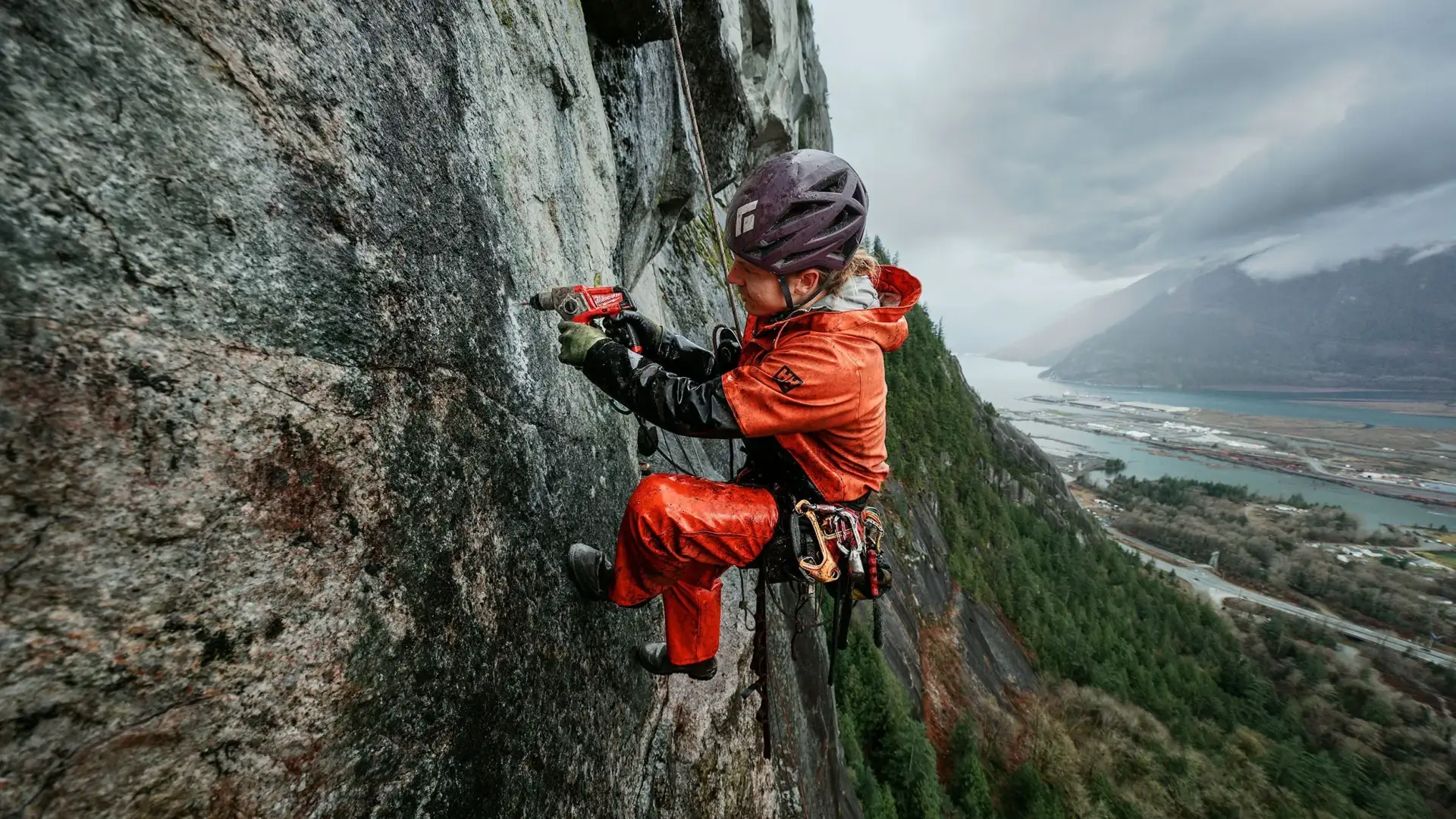
Photo by: Alex Ratson of Evan Beatty scrubbing his new multi “Ballad of Rock Ridge”
What we fund
The fund pays for fixed hardware used in ongoing route development: bolts, hangers, anchors, chains, and related gear. We support development across a wide grade range so more climbers can enjoy new routes in Squamish and the Sea to Sky region.

Photo by: Leonardo Iezzi of Leonardo Moretto leading the traverse pitch of the grand wall
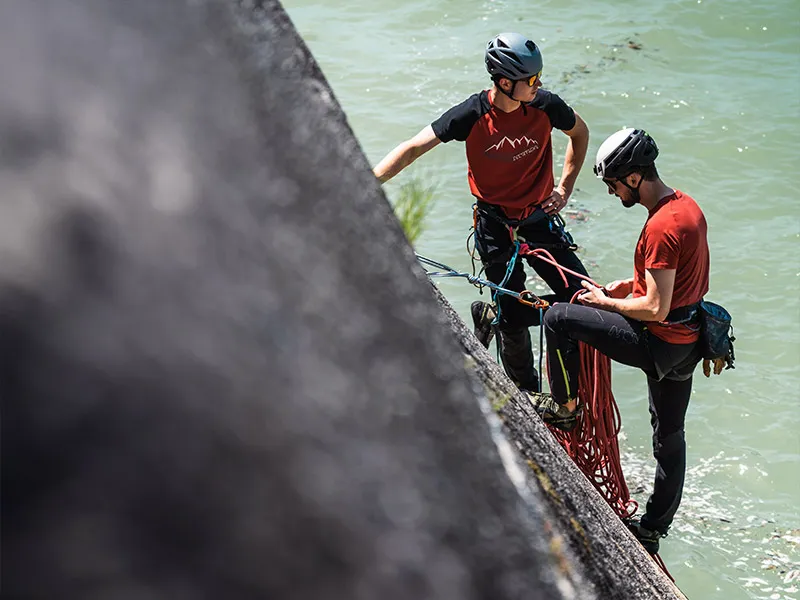
Photo by: Leonardo Iezzi of Lukas Fournier and Anton De Bruin
How it works
The Bolt Fund turns climber donations into new routes. Submitted hardware requests from route developers are reviewed and approved, releasing funding for bolts, hangers, and anchors. Developers put that hardware to work, bolting new routes, multi-pitch lines, and whole new crags. New climbs bring climbers back to the crags they love.
News
Special thanks
Donate to the fund
Donations fund bolts and hardware for Sea to Sky routes.
Request funding
Before you apply, make sure you meet the requirements below. When you're ready, use the button at the bottom to send your request.
Eligibility
- ✓ You are a Squamish Access Society member.
- ✓ You are developing routes in the Sea to Sky corridor.
- ✓ You have appropriate land access or permissions where required. As per iMap BC.
- ✓ You are committed to proper installation practices and community standards.
- ✓ You have equipped or opened 10 new pitches of climbing at your own expense in the Sea to Sky region.
Standards and ethics
- ✓ Bolts and hardware must be installed to accepted community standards.
- ✓ Development should align with local access guidelines (SAS) and land-manager expectations.
- ✓ Abide by the manufacturer's guidelines for hardware installation and usage.
What we can cover
- ✓ Bolts, hangers, anchors, chains, and related fixed hardware.
- ✓ Hardware is typically provided in part or in full, depending on the request and fund availability.
- ✓ We do not fund travel, labour, or gear for personal use.
- ✓ We do not fund route maintenance or the replacement of old bolts.
Information required
- ✓ Location (crag/area) and brief description of the project.
- ✓ Amount and type of hardware needed.
- ✓ Your contact details and any relevant experience or context.
- ✓ Topo of crag or routes developed upon completion with Bolt Fund sticker on it.
Review and timeline
- ✓ Requests are reviewed by the board on a rolling basis.
- ✓ You will receive a response typically within a few weeks.
- ✓ Approved requests are funded as the process is completed.
Ready to submit? Open the form below to provide the details we need.
Crag database
Submit TopoThese are crags we've supported with hardware funding in the Sea to Sky corridor. Click a pin for details and to download PDF guides. If a topo is missing, please use the Submit Topo button above to send it to us.
Route Database
Submit TopoBrowse Sea to Sky routes we've supported from our route database. Filter by type, search by name or location, and download the full PDF. If a topo is missing, please use the Submit Topo button above to send it to us.
Contact us
Have a question about the fund, a request, or something else? Send us a message.
About
The Sea to Sky Bolt Fund Society is a registered BC non-profit society based in Squamish, run by local climbers Leonardo Iezzi, Daniel Guestrin, Paul McSorley, and Luke Neufeld. Our primary mission is to support route development throughout the Sea to Sky corridor by funding the hardware that makes new routes possible: bolts, hangers, anchors, and all the hardware that goes into building quality, lasting climbs for the community.
The bolt fund was originally established in 2018 and has been a major source of hardware for route developers in the corridor ever since. It's simple: more donations means more routes. We're committed to keeping that momentum going.
Alongside the fund, we maintain this website as a central database for new route information, a place to find the latest cleaned routes and topos for recently developed crags in the area. The site was originally created by Squamish climbers Peter Winter and Tom Wright out of a desire to replace the fragmented spread of new route info across Facebook, Instagram, Mountain Project, and word of mouth. We've carried that vision forward. This remains a grassroots, no-profit, no-copyright resource. We post routes as described to us by developers; it's a database, nothing more.
If you climb in the Sea to Sky, consider donating to the fund. Every dollar goes directly toward putting bolts in rock.
Directors
Constitution & Bylaws
The Sea to Sky Bolt Fund Society is governed by its constitution and bylaws. Below is a summary; the full documents are available for download.
Constitution
Name of the Society: SEA TO SKY BOLT FUND SOCIETY
The name of the Society is SEA TO SKY BOLT FUND SOCIETY.
Purposes of the Society:
The purpose of the Society is to raise, manage, and distribute funds to support the development of climbing routes in the Sea to Sky region through the provision of fixed climbing hardware and related materials, in order to enhance public recreational opportunities and access to climbing.
Bylaws
Bylaws of SEA TO SKY BOLT FUND SOCIETY (the “Society”). Filed with the Province of British Columbia Registrar of Companies. Incorporation Number: S0084697.
PART 1 – DEFINITIONS AND INTERPRETATION
1.1 In these Bylaws: “Act” means the Societies Act of British Columbia as amended from time to time; “Board” means the directors of the Society; “Bylaws” means these Bylaws as altered from time to time.
1.2 The definitions in the Act apply to these Bylaws.
1.3 If there is a conflict between these Bylaws and the Act or the regulations under the Act, the Act or the regulations, as the case may be, prevail.
PART 2 – MEMBERS
2.1 A person may apply to the Board for membership in the Society, and the person becomes a member on the Board’s acceptance of the application.
2.2 Every member must uphold the constitution of the Society and must comply with these Bylaws.
2.3 The amount of the annual membership dues, if any, must be determined by the Board.
2.4 A member is not in good standing if the member fails to pay the member’s annual membership dues, if any, and the member is not in good standing for so long as those dues remain unpaid.
2.5 A voting member who is not in good standing (a) may not vote at a general meeting, and (b) is deemed not to be a voting member for the purpose of consenting to a resolution of the voting members.
2.6 A person’s membership in the Society is terminated if the person is not in good standing for 6 consecutive months.
PART 3 – GENERAL MEETINGS OF MEMBERS
3.1 A general meeting must be held at the time and, if applicable, place the Board determines.
3.2 At a general meeting, the following business is ordinary business: (a) adoption of rules of order; (b) consideration of any financial statements of the Society presented to the meeting; (c) consideration of the reports, if any, of the directors or auditor; (d) election or appointment of directors; (e) appointment of an auditor, if any; (f) business arising out of a report of the directors not requiring the passing of a special resolution.
3.3 A notice of a general meeting must state the nature of any business, other than ordinary business, to be transacted at the meeting in sufficient detail to permit a member receiving the notice to form a reasoned judgment concerning that business.
3.4 The following individual is entitled to preside as the chair of a general meeting: (a) the individual, if any, appointed by the Board to preside as the chair; (b) if the Board has not appointed an individual to preside as the chair or the individual appointed by the Board is unable to preside as the chair, (i) the president, (ii) the vice-president, if the president is unable to preside as the chair, or (iii) one of the other directors in attendance at the meeting, if both the president and vice-president are unable to preside as the chair.
3.5 If there is no individual entitled under these Bylaws who is able to preside as the chair of a general meeting within 15 minutes from the time set for holding the meeting, the voting members who are in attendance must elect an individual present at the meeting to preside as the chair.
3.6 Business, other than the election of the chair of the meeting and the adjournment or termination of the meeting, must not be transacted at a general meeting unless a quorum of voting members is in attendance.
3.7 The quorum for the transaction of business at a general meeting is 3 voting members or 10% of the voting members, whichever is greater.
3.8 If, within 30 minutes from the time set for holding a general meeting, a quorum of voting members is not in attendance, (a) in the case of a meeting convened on the requisition of members, the meeting is terminated, and (b) in any other case, the meeting stands adjourned to the same day in the next week, at the same time and, if applicable, place, and if, at the continuation of the adjourned meeting, a quorum is not present within 30 minutes from the time set for holding the continuation of the adjourned meeting, the voting members who are present constitute a quorum for that meeting.
3.9 If, at any time during a general meeting, there ceases to be a quorum of voting members present, business then in progress must be suspended until there is a quorum in attendance or until the meeting is adjourned or terminated.
3.10 The chair of a general meeting may, or, if so directed by the voting members at the meeting, must, adjourn the meeting from time to time and, if applicable, from place to place, but no business may be transacted at the continuation of the adjourned meeting other than business left unfinished at the adjourned meeting.
3.11 It is not necessary to give notice of a continuation of an adjourned general meeting or of the business to be transacted at a continuation of an adjourned general meeting except that, when a general meeting is adjourned for 30 days or more, notice of the continuation of the adjourned meeting must be given.
3.12 The order of business at a general meeting is as follows: (a) elect an individual to chair the meeting, if necessary; (b) determine that there is a quorum; (c) approve the agenda; (d) approve the minutes from the last general meeting; (e) deal with unfinished business from the last general meeting; (f) if the meeting is an annual general meeting, (i) receive the directors’ report on the financial statements of the Society for the previous financial year, and the auditor’s report, if any, on those statements, (ii) receive any other reports of directors’ activities and decisions since the previous annual general meeting, (iii) elect or appoint directors, and (iv) appoint an auditor, if any; (g) deal with new business, including any matters about which notice has been given to the members in the notice of meeting; (h) terminate the meeting.
3.13 At a general meeting, voting must be by a show of hands, an oral vote or another method that adequately discloses the intention of the voting members, except that if, before or after such a vote, 2 or more voting members request a secret ballot or a secret ballot is directed by the chair of the meeting, voting must be by a secret ballot.
3.14 The chair of a general meeting must announce the outcome of each vote and that outcome must be recorded in the minutes of the meeting.
3.15 Voting by proxy is not permitted.
3.16 A matter to be decided at a general meeting must be decided by ordinary resolution unless the matter is required by the Act or these Bylaws to be decided by special resolution or by another resolution having a higher voting threshold than the threshold for an ordinary resolution.
PART 4 – DIRECTORS
4.1 The Society must have no fewer than 3 and no more than 11 directors.
4.2 At each annual general meeting, the voting members entitled to vote for the election or appointment of directors must elect or appoint the Board.
4.3 The Board may, at any time, appoint a member as a director to fill a vacancy that arises on the Board as a result of the resignation, death or incapacity of a director during the director’s term of office.
4.4 A director appointed by the Board to fill a vacancy ceases to be a director at the end of the unexpired portion of the term of office of the individual whose departure from office created the vacancy.
PART 5 – DIRECTORS’ MEETINGS
5.1 A directors’ meeting may be called by the president or by any 2 other directors.
5.2 At least 2 days’ notice of a directors’ meeting must be given unless all the directors agree to a shorter notice period.
5.3 The accidental omission to give notice of a directors’ meeting to a director, or the non-receipt of a notice by a director, does not invalidate proceedings at the meeting.
5.4 The directors may regulate their meetings and proceedings as they think fit.
5.5 The quorum for the transaction of business at a directors’ meeting is a majority of the directors.
PART 6 – BOARD POSITIONS
6.1 Directors must be elected or appointed to the following Board positions, and a director, other than the president, may hold more than one position: (a) president; (b) vice-president; (c) secretary; (d) treasurer.
6.2 Directors who are elected or appointed to positions on the Board in addition to the positions described in these Bylaws are elected or appointed as directors at large.
6.3 The president is the chair of the Board and is responsible for supervising the other directors in the execution of their duties.
6.4 The vice-president is the vice-chair of the Board and is responsible for carrying out the duties of the president if the president is unable to act.
6.5 The secretary is responsible for doing, or making the necessary arrangements for, the following: (a) issuing notices of general meetings and directors’ meetings; (b) taking minutes of general meetings and directors’ meetings; (c) keeping the records of the Society in accordance with the Act; (d) conducting the correspondence of the Board; (e) filing the annual report of the Society and making any other filings with the registrar under the Act.
6.6 In the absence of the secretary from a meeting, the Board must appoint another individual to act as secretary at the meeting.
6.7 The treasurer is responsible for doing, or making the necessary arrangements for, the following: (a) receiving and banking monies collected from the members or other sources; (b) keeping accounting records in respect of the Society’s financial transactions; (c) preparing the Society’s financial statements; (d) making the Society’s filings respecting taxes.
PART 7 – REMUNERATION OF DIRECTORS AND SIGNING AUTHORITY
7.1 These Bylaws do not permit the Society to pay to a director remuneration for being a director, but the Society may, subject to the Act, pay remuneration to a director for services provided by the director to the Society in another capacity.
7.2 A contract or other record to be signed by the Society must be signed on behalf of the Society (a) by the president, together with one other director, (b) if the president is unable to provide a signature, by the vice-president together with one other director, (c) if the president and vice-president are both unable to provide signatures, by any 2 other directors, or (d) in any case, by one or more individuals authorized by the Board to sign the record on behalf of the Society.
Last updated for reference: the society maintains current copies of its constitution and bylaws with the relevant provincial registry. Filed February 20, 2026.